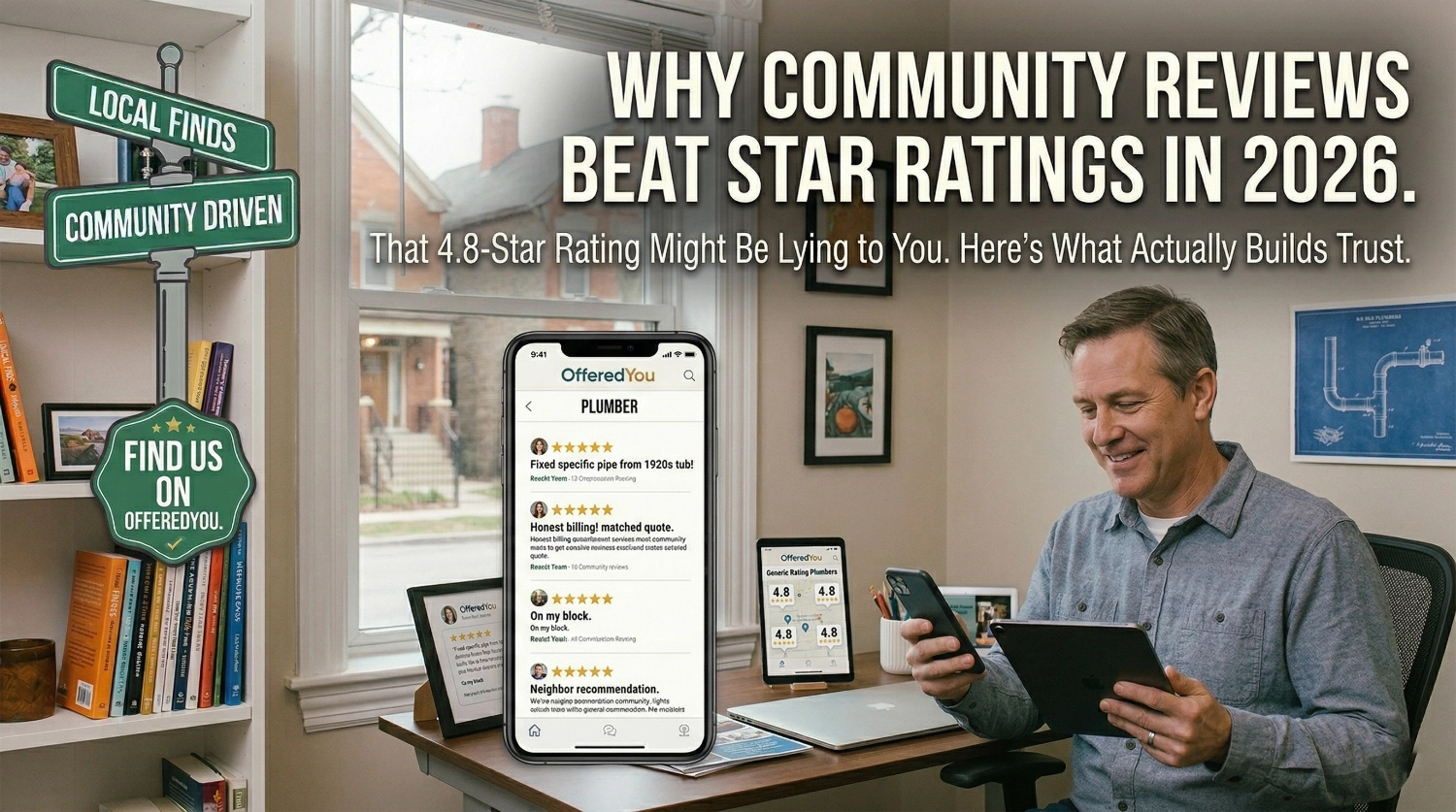
Why Community Reviews Beat Star Ratings in 2026
Olivia Thompson
April 12, 2026
That 4.8-Star Rating Might Be Lying to You. Here's What Actually Builds Trust.
Last fall, I needed a plumber. My kitchen sink had been dripping for a week, and I'd finally hit the point where the sound of water hitting a pot at 2 a.m. broke me. I did what everyone does. I Googled "plumber near me," found three options with near-perfect star ratings, and picked the one with the most reviews.
He showed up four hours late, charged double the estimate, and left without fixing the drip completely.
A week later, my neighbor mentioned a plumber she'd been using for years. "He's on OfferedYou," she said. "Only has about 20 reviews, but read them. They're all from people in the neighborhood."
I read them. They were specific. One mentioned he'd fixed a tricky pipe under a 1920s bathtub. Another said he explained the whole repair before starting, and the final bill matched the quote exactly. A third review was from someone on my block.
That plumber fixed my sink in an hour and charged exactly what he said he would. No surprises.
The difference wasn't the number of stars. It was the quality and source of the reviews. And that gap between star ratings and genuine community feedback has become one of the most important things to understand when choosing local businesses in 2026.
TL;DR: Star ratings alone are increasingly unreliable. Community reviews from real neighbors on platforms like OfferedYou carry more trust because they come from identifiable, local people with shared context. In 2026, smart consumers cross-reference multiple platforms, prioritize review recency, and look for specific details over raw star counts.
The Star Rating Problem Nobody Talks About
Five stars used to mean something. Now, it's complicated.
The 2026 trust gap around online reviews has reached a real tipping point. AI-generated content and bot-driven reviews have flooded major platforms. Consumers are starting to ask a question that would've sounded paranoid a few years ago: "Is this review even real?"
BrightLocal's 2026 Local Consumer Review Survey found that consumers now expect higher star ratings and more recent reviews than ever before, with a sharp increase in people who will only consider businesses with 4.5 stars or above. But here's the twist. At the same time, consumers are getting better at spotting patterns that feel manufactured. A business with nothing but glowing five-star reviews actually raises red flags. People know no business is perfect, and a profile full of perfection looks suspicious.
I experienced this myself when choosing a restaurant for my partner's birthday. The place had 4.9 stars and over 2,000 reviews on a major platform. We went. The food was mediocre, the service was distracted, and the "romantic atmosphere" they advertised turned out to be a noisy room with fluorescent lighting in the back. Those 2,000 reviews didn't reflect reality. Or at least, they didn't reflect my reality.
What Makes a Community Review Different
A community review is written by someone who lives in your area, shops at your stores, and has skin in the game. They're not a drive-by reviewer who visited once on vacation. They're a person whose recommendation affects their own neighborhood.
On OfferedYou's discussion boards, neighbors ask each other directly for recommendations. "Who's a good mechanic near Lincoln Park?" "Any reliable tutors in Mesa?" These conversations create recommendations with context. You can see who's recommending, check their other reviews, and often recognize the streets and landmarks they mention.
That context changes everything. Research shows that neighborhood-verified contributors produce higher authenticity signals than public review platforms because the reviewers are identifiable within their community. When your neighbor recommends a restaurant and you can see they also reviewed the coffee shop you already love, that second-degree trust makes their recommendation stick.
The best community reviews share specific details. They mention a server by name, describe a particular dish, explain exactly what went wrong or right. This specificity is what separates a genuine experience from a templated five-star review that could apply to any business anywhere.
Why Cross-Referencing Is the New Normal
Here's something that changed how I think about choosing local businesses. I used to pick one platform, read a few reviews, and decide. Now I check at least two or three sources. And I'm not unusual.
Research shows that the vast majority of consumers use at least two review platforms before choosing a local business. Many use three or more. People cross-reference. They'll check a Google listing, then verify details on a community directory like OfferedYou, then maybe glance at social media. If all three sources tell a consistent story, trust multiplies. If they contradict each other, trust evaporates.
This cross-referencing behavior is why it matters for businesses to be listed on community-focused platforms alongside the big directories. If someone finds your business on Google but can't find real community feedback anywhere else, that gap creates doubt. But if they find your Google listing AND see genuine neighborhood reviews on OfferedYou, you've just earned a level of trust that a single platform can't deliver.
We wrote a full guide on how to list your business on OfferedYou if you want to close that gap.
The Review Details That Actually Build Trust
Not all reviews are created equal, even among honest ones. After reading hundreds of reviews across different platforms while researching this topic, I started noticing patterns in which reviews actually influenced my decisions.
Recency matters more than volume. A business with 50 reviews from the past six months feels more trustworthy than one with 500 reviews that haven't been updated in two years. Stale reviews suggest the business might have changed. Fresh reviews suggest it's still delivering.
Specifics beat generalities. "Great service!" tells me nothing. "Maria at the front desk remembered my name from last time and had my usual order ready" tells me everything. The reviews that mention staff names, particular products, exact problems and their solutions carry real weight.
A mix of ratings feels more honest. If every single review is five stars, something's off. A healthy spread that includes some three-star and four-star feedback actually builds more confidence. I trust a business with a 4.3 average and visible constructive criticism more than a pristine 5.0.
Owner responses reveal character. When a business responds to reviews, especially negative ones, professionally and specifically, I notice. It shows they're engaged and accountable. Businesses that respond to most of their reviews see significantly higher conversion rates than those that stay silent. If you own a business and want to build this habit, our review strategy guide walks through exactly how.
Where AI Recommendations Fit In
Something new happened in 2026. Consumers started asking AI tools like ChatGPT and Perplexity for local business recommendations. BrightLocal's research found that AI tools have surged into third place for local business recommendations, behind traditional search and word-of-mouth but ahead of some established review platforms.
This shift makes community-based content more valuable, not less. AI recommendation engines pull from structured, citation-friendly content across the web. When your business has detailed, genuine reviews on a platform like OfferedYou, with accurate business information and specific customer experiences documented, that content becomes source material for AI-driven recommendations too.
The businesses winning in 2026 aren't just optimizing for Google. They're building a genuine reputation across community platforms, keeping their information accurate everywhere customers search, and generating a steady stream of authentic reviews that AI tools can reference.
How to Read Reviews Like a Local
After my plumber disaster, I developed a system for evaluating reviews that's saved me from bad decisions dozens of times. Here's what I look for.
I start by checking the reviewer's other activity. On OfferedYou, I can see if someone has reviewed other local businesses. A reviewer who's written about three restaurants and a hair salon in my neighborhood feels more trustworthy than an account with one review ever.
I scan for the freshest reviews first. Anything older than six months gets less weight in my mental calculation. A business that was great two years ago might have new management now.
I look for reviews that describe a problem and how it was handled. A four-star review that says "the order was wrong but they fixed it immediately and gave us a dessert" tells me more about a business's character than twenty five-star reviews saying "loved it."
I check whether the business responds to reviews. If they engage with both praise and criticism, I know they're paying attention. That matters.
And I cross-reference. If the OfferedYou reviews match what I see on Google and what my neighbors say in discussions, I'm confident. If they tell different stories, I dig deeper or move on.
For more strategies on finding trustworthy businesses in your area, read our guide on how to find the best local businesses in your neighborhood.
Key Facts
- Consumers with access to 4.5+ stars are increasingly likely to choose those businesses over lower-rated ones
- Reviews with verified customer indicators are trusted significantly more than unverified ones
- Most consumers use at least two review platforms before choosing a local business
- Reviews older than six months carry substantially less weight in consumer decisions
- Businesses responding to 75%+ of reviews see approximately 35% higher conversion rates
- AI tools have become the third most popular source for local business recommendations in 2026
- A healthy mix of ratings (including some 3 and 4 stars) builds more trust than all-5-star profiles
- Review detail in the 100-150 word range hits the trust sweet spot for consumers
- Community-verified reviewers produce higher authenticity signals than anonymous public reviewers
- Specific details in reviews (staff names, exact products, precise problems) drive trust the most
FAQ
Why should I trust community reviews over reviews on larger platforms? Community reviews come from identifiable people in your neighborhood who have ongoing relationships with local businesses. Their recommendations carry personal accountability. On larger platforms, reviews often come from one-time visitors or, increasingly, from bots and AI-generated content.
How do I know if a review is real? Look for specific details like staff names, particular products, and described interactions. Check the reviewer's history. On community platforms like OfferedYou, reviewers often have multiple reviews of local businesses, which adds credibility. Be cautious of vague, overly enthusiastic reviews with no specifics.
Do businesses pay for reviews on OfferedYou? No. OfferedYou's reviews come from genuine community members. While businesses can upgrade to paid plans for features like analytics and promoted placement, reviews themselves are organic and cannot be purchased or manipulated.
Should I still check Google reviews too? Yes. The smartest approach is cross-referencing across multiple platforms. Check Google, check OfferedYou, and ideally check at least one more source. When multiple platforms tell the same story, your confidence in choosing that business goes up significantly.
How can I leave a helpful community review? Be specific. Mention what you ordered, who helped you, what went right or wrong, and whether you'd return. Aim for 100-150 words. Include context that helps neighbors make decisions, like parking availability or wait times during peak hours.
Are star ratings completely useless now? Not useless, but insufficient on their own. Star ratings are a useful starting filter, but the actual review content, recency, and source matter much more for making a confident decision. Think of stars as a first glance, not the full picture.