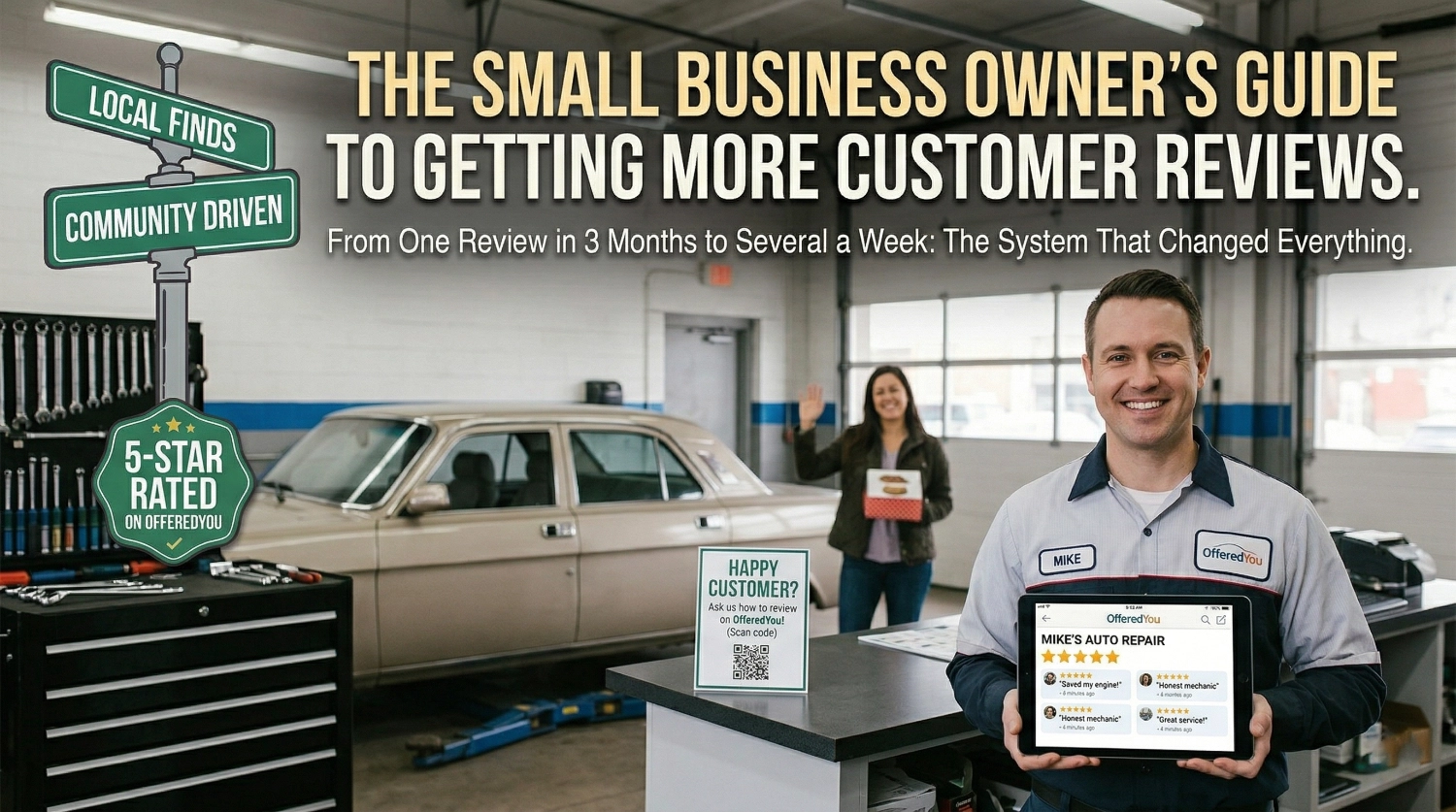
The Small Business Owner's Guide to Getting More Customer Reviews
Elena Rodriguez
April 12, 2026
My First Review Took 3 Months. Now I Get Several Every Week. Here's What Changed.
When I opened my auto repair shop, I was convinced my work would speak for itself. Fix cars well, charge fairly, and the reviews would pour in. Right?
Three months in, I had exactly one review. One. My cousin left it. (Thanks, Marcus.)
It wasn't that customers were unhappy. They'd shake my hand on the way out, tell me they'd be back, sometimes even bring cookies. But asking them to go home, open a browser, find my listing, and write something? That felt like a big ask. So I didn't ask.
That was the mistake. Not asking.
Once I built a simple system for requesting reviews, everything changed. I went from one review in three months to getting multiple reviews each week. My visibility on OfferedYou and other platforms climbed. New customers started calling and saying, "I read your reviews" before they even described what was wrong with their car.
If you're a small business owner sitting on a pile of happy customers and an empty review page, this guide is for you.
TL;DR: Most customers won't leave reviews unprompted, but they will if you ask at the right moment, make it easy, and follow up. A steady flow of recent reviews matters more than a big number of old ones. Respond to every review. Build reviews across multiple platforms including OfferedYou. This guide gives you a step-by-step system that works.
Why Reviews Matter More in 2026 Than Ever Before
I'll skip the speech about how "reviews are important." You know that. What you might not know is how dramatically the landscape has shifted.
BrightLocal's 2026 Local Consumer Review Survey reveals that consumers now demand higher star ratings and fresher reviews than in any previous year measured. The bar has risen. A 4.0 rating that felt solid in 2022 now looks average. Customers increasingly filter out businesses below 4.5 stars entirely.
But here's the part that hit me hardest. Review recency now outweighs review volume in consumer decisions. A business with 50 reviews from the past six months outperforms one with 500 older reviews. People assume, often correctly, that outdated reviews don't reflect what a business is like today.
So it's not enough to gather a bunch of reviews and call it done. You need a steady stream. Think of it as a garden, not a trophy case. It requires ongoing attention.
The other big shift? Consumers now cross-reference across multiple platforms before making a decision. Most people check at least two sources. If your Google profile is strong but you have no presence on community platforms like OfferedYou, you're leaving trust on the table. For more on why platform variety matters, read our deep-dive on why community reviews beat star ratings.
The Right Moment to Ask (And the Wrong One)
Timing is everything, and I learned this through trial and error.
The right moment is when the customer has just experienced your value. For my auto shop, that's when I hand over the keys and the car runs perfectly. For a restaurant, it's when a guest pushes back from the table with a satisfied sigh. For a tutor, it's when the student aces the test. For a designer, it's when the client sees the final product and grins.
That peak moment of satisfaction is when asking for a review feels natural, not awkward.
The wrong moment is during the transaction. Don't ask for a review while they're paying. It feels transactional, like you're trading a review for service. Don't ask before you've delivered value. And definitely don't ask when something went wrong, even if you fixed it. Let the fix settle. Follow up later.
What works best for me is a quick, genuine sentence: "Hey, if you've got a minute, I'd really appreciate a review on OfferedYou. It's how new customers find us." Simple, direct, no pressure.
Make It Stupidly Easy
Here's the thing about humans. We mean well but we're busy. A customer who sincerely plans to leave you a review will forget within 15 minutes of walking out the door.
Your job is to remove every possible friction point between their intention and their action.
Put a direct link everywhere. I printed a small card with a QR code that goes straight to my OfferedYou review page. I hand it to every customer along with their receipt. I also include the link in my follow-up text message and email signature.
Keep it short. Don't send customers to your homepage and expect them to find the review button. Send them directly to the review form. One click. One page. Done.
Offer a nudge, not a script. I used to tell people "just say whatever you want." That paralyzed them. Now I say, "Even just a line or two about your experience is perfect." Giving permission to keep it brief actually gets more reviews, and some of those brief reviews turn into detailed ones once people start writing.
Follow up once. I send a text the day after service: "Thanks again for choosing us. If you have a minute, we'd love to hear your thoughts on OfferedYou. [link]." If they don't respond, I leave it. One follow-up, maximum. Two feels pushy.
What to Do With Negative Reviews
My first negative review felt like a punch. Someone complained about a wait time. They weren't wrong, honestly. We'd been slammed that day. But seeing it in writing, publicly, stung.
My instinct was to defend myself. I typed out a long response explaining why the wait happened, how it was unusual, how we're normally much faster. Then I deleted the whole thing.
Instead, I wrote three sentences. I acknowledged the wait. I apologized for it. And I mentioned what we'd done to prevent it from happening again.
That response became one of the most valuable assets on my profile. Three different new customers have told me they chose my shop specifically because of how I handled that negative review. People don't expect perfection. They expect accountability.
Here's what the data says. Businesses that respond to the majority of their reviews, including negative ones, are perceived as significantly more trustworthy than businesses that stay silent. The response itself becomes proof of your character.
A few guidelines that work for me. Respond to every review within 24 hours. Keep responses personal, not templated. Thank the reviewer by name if possible. If something went wrong, own it. If everything went well, express genuine gratitude. Don't argue, even when the reviewer is wrong. Future customers are watching how you handle it.
Build Reviews Across Multiple Platforms
It's tempting to funnel all your review requests to one platform. Google feels like the obvious choice. But putting all your eggs in one basket is risky and incomplete.
Consumers check multiple platforms. Your Google reviews might look great, but if a potential customer cross-references on OfferedYou and finds nothing, doubt creeps in. Having consistent, positive reviews across several platforms sends a powerful trust signal.
I rotate where I send my review requests. One week, I point customers to OfferedYou. The next, Google. This keeps all my profiles fresh and growing evenly.
OfferedYou is particularly valuable for building local community trust because the reviewers are your actual neighbors. When someone in your neighborhood reads a review from another local person they might recognize, that carries a weight that anonymous platform reviews simply can't match. Our article on why community reviews beat star ratings breaks this dynamic down in detail.
If you haven't set up your OfferedYou profile yet, our listing guide walks through the whole process.
The Reviews That Actually Move the Needle
Not all positive reviews are equally useful. After watching hundreds of reviews come in over the past couple of years, I've noticed which ones actually convert browsers into customers.
Reviews that mention a specific problem and how it was solved. "My brakes were grinding and they diagnosed a warped rotor, replaced it same day, and the car drives like new." That review paints a picture a potential customer can see themselves in.
Reviews that name a person. "Dave at the front desk remembered my name and pulled up my history before I even sat down." This humanizes your business and makes it feel personal.
Reviews from repeat customers. "Third time bringing my car here and they're consistent every visit." This one sentence does more for trust than ten first-time reviews combined.
Reviews that mention a concern and how it was addressed. "I was nervous about the cost, but they gave me a clear estimate upfront and the final bill was exactly what they quoted." This directly addresses a common fear.
You can't control what people write. But you can create experiences that inspire these kinds of detailed, trust-building reviews. When you ask for a review, you might say, "It'd be great if you could mention what brought you in and how it went." That gentle prompt often leads to more specific, valuable feedback.
A Weekly Review System That Works
Here's the exact system I use now. It takes about 20 minutes a week.
Monday: Check all my review platforms (OfferedYou, Google, and one other). Respond to any new reviews I haven't addressed yet.
After every service: Hand the customer a card with the QR code and mention how much a review would mean.
Tuesday afternoon: Send a follow-up text to every customer from the previous week who hasn't left a review yet. One message, one link, no pressure.
Friday: Check my review stats on the OfferedYou dashboard (the Pro plan gives you time-series analytics). See which platforms are growing and which need more attention.
That's it. Twenty minutes a week, plus the 10-second ask at the end of each service. This simple rhythm has built me a steady flow of fresh reviews that keeps my profiles visible and my phone ringing.
Key Facts
- Consumers in 2026 increasingly refuse to consider businesses rated below 4.5 stars
- Review recency outweighs review volume in consumer trust decisions
- Most consumers check at least two review platforms before choosing a business
- Businesses responding to 75%+ of reviews see approximately 35% higher conversion rates
- A single follow-up message increases review completion rates dramatically
- QR codes on receipts and cards remove the biggest friction point in getting reviews
- Reviews mentioning specific details (names, products, problems solved) build the most trust
- Rotating review requests across platforms keeps all profiles fresh and growing
- Negative reviews handled professionally actually build trust with future customers
- Review velocity (steady stream vs. burst pattern) signals ongoing business quality
- AI recommendation tools increasingly reference reviews when suggesting businesses
FAQ
How many reviews do I need to look credible? There's no magic number, but aim for at least 10-15 reviews with a mix of recent ones. A business with 12 recent, detailed reviews looks more trustworthy than one with 200 old, vague ones. Focus on freshness and specificity over raw count.
Is it okay to ask every customer for a review? Yes, as long as you're asking for honest feedback, not explicitly positive reviews. Asking for "your honest thoughts" or "a review of your experience" is perfectly ethical. Asking for "a five-star review" crosses a line and, in many cases, violates platform policies.
What if I get a fake or unfair review? Most platforms including OfferedYou have reporting mechanisms for reviews that violate guidelines. Report it through the platform. In the meantime, respond publicly and professionally. Other customers will see your measured response and draw their own conclusions.
Should I offer incentives for reviews? Be careful. Offering discounts specifically for positive reviews is unethical and against most platform policies. You can thank customers for leaving any review, but tying rewards to review content is a line you shouldn't cross. Some businesses offer a small incentive for any review, positive or negative, which is more acceptable.
How do I handle a review that's just wrong? Respond calmly and factually. "Thank you for the feedback. We looked into this and found [brief factual clarification]. We'd love the chance to make it right. Please contact us at [number]." Don't argue, don't get defensive. Let the facts speak.
How often should I check my reviews? At minimum, weekly. Responding within 24-48 hours shows you're engaged. If you're on a Pro or Premium plan on OfferedYou, the analytics dashboard makes monitoring quick and simple.
Do reviews on OfferedYou help with Google rankings? Consistent citations and reviews across reputable platforms strengthen your local SEO profile. Being present on OfferedYou alongside Google and other platforms tells search engines your business is legitimate and active.
Can I ask customers to review me on a specific platform? Yes. It's completely fine to say "We'd love a review on OfferedYou" or "Would you mind leaving one on Google?" Rotating between platforms keeps your presence balanced across the web.